


NEWS - August 5, 2025
Number of gay and lesbian places stayed stable for 10 years
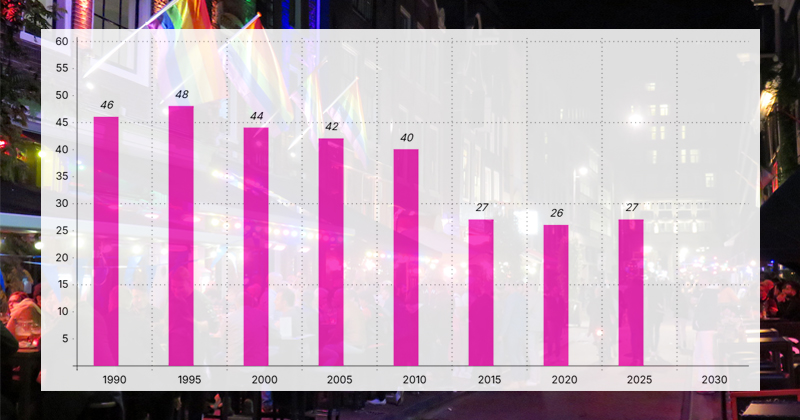
Development of the gay and lesbian places from 1990 to 2025
Although it's often the perception that the number of gay bars is going down, figures show that the number of LGBTQ nightlife venues in Amsterdam has remained stable over the past 10 years. This is striking because the total number of bars in the city declined during the same period.
Currently, there are 27 LGBTQ nightlife venues in Amsterdam: 19 gay bars, 3 lesbian bars, and 5 queer and cruise clubs. There is also one gay sauna and one sex club. The number of LGBT bars therefore represents only 2.2% of the total number of bars in the city, which is considerably lower than the percentage of LGBT people in Amsterdam.
The peak of Amsterdam's gay nightlife was in the 1980s: in 1984, there were 42 gay bars, 7 lesbian bars and 12 discos in Amsterdam, totaling a whopping 61 establishments, plus four gay saunas and six sex clubs. Afterward, this number gradually decreased, to 48 in 1995 and 40 in 2010.
Decline from 2010 to 2015
A strikingly large decline occurred between 2010 and 2015, when the number of places fell from 40 to 27. 2010, in particular, was considered a disastrous year. All well-known gay venues in Reguliersdwarsstaat (April, ARC, Downtown, Club Exit, Exit Café and Soho) closed due to the collapse of the business empire of their owner, bar tycoon Sjoerd Kooistra. In addition, two places on Warmoesstraat also closed.
The latter places did reopen, but in 2015, Warmoesstraat finally lost the famous locations of the Argos bar and the Cockring club. Most venues in Reguliersdwarsstaat also reopened, albeit with fits and starts. However, the cafés along the Amstel River began to disappear one by one from 2010 onwards due to declining patronage and increasing tourism.
The same happened in the northern part of the Zeedijk, which was quite popular around 2010, but where three of the four gay cafés closed permanently between 2013 and 2016. Elsewhere in the city center, cafés such as Sappho, Mon Ami (formerly De Krokodil), Habibi Ana, and The Music Box also closed during this period.

In 2012, Queen's Day was still celebrated outside
the gay places alongside the Amstel river
the gay places alongside the Amstel river
Causes of the closures
The closure of gay bars is generally attributed to the rise of online dating and dating apps like Grindr. While that likely plays a role, there are other factors. For example, going out to bars has generally declined, and people are going to restaurants more often (see the graph below). Festivals have also become increasingly popular.
Furthermore, gay places have also simply closed because the owner experienced financial difficulties or retired, the place was no longer attractive, or there were problems with the neighborhood and/or the permit. With the very small number of gay businesses, such individual factors have a relatively large impact.

Development of the number of cafés and restaurants in Amsterdam, 1994-2024
What also didn't benefit the gay bar scene at the time was the idea that separate venues for gays were no longer necessary. Mixed places were seen as the future. This changed after the attack on the gay nightclub Pulse in Orlando in June 2016. This led to the realization that it's still important for LGBTQ people to have their own places to go out safely.
Changes between 2015 and 2025
In line with this new understanding, the number of nightlife venues for LGBT people hasn't decreased since 2016. While a number of bars closed afterward, new places were constantly popping up in their place. Furthermore, two old locations were revived (with Blend XL and Free Willie), and two bars were relocated (Getto and Montmartre).
Although the number of places remained the same, some shifts did occur. For example, the number of gay places in Warmoesstraat and Zeedijk has halved, and gay bars along the Amstel river and in Halvemaansteeg, once the largest concentration of gay places, have completely disappeared. Nowadays the largest concentration is found in Reguliersdwarsstraat, where the number of businesses has increased.

An increasingly colorful Reguliersdwarsstraat in June 2020
Outlook
The fact that the number of places has been stable for 10 years doesn't mean the threat to the gay and lesbian nightlife has passed. Just like the hospitality business in general, many LGBT businesses still have high debts from the coronavirus pandemic, which in recent years have been compounded by rent increases, higher purchase prices, and staff shortages.
In particular the sharply rising rents have made it increasingly difficult to open a new bar or club in the old city center. For several years now, these have been opening elsewhere in the city, such as Bar Buka, Pamela, Lola the Green Aardvark and Club RAUM. These places are closer to local visitors, but less accessible to tourists.
Do you want to follow gay nightlife news from Amsterdam without relying on Big Tech? Then subscribe to our RSS feed!
More news
March 31, 2026:
February 22, 2026:
November 17, 2025:
August 5, 2025:
July 2, 2025:
May 12, 2025:
September 13, 2024:
September 8, 2024:
June 24, 2024:
April 22, 2024:
December 15, 2023:
November 22, 2023:
April 11, 2023:
February 21, 2023:
July 15, 2022:
February 19, 2022:
February 13, 2022:
April 21, 2021:
October 14, 2020:
News about Reguliersdwarsstraat: Reguliers.net
2026
March 31, 2026:
February 22, 2026:
2025
November 17, 2025:
August 5, 2025:
July 2, 2025:
May 12, 2025:
2024
September 13, 2024:
September 8, 2024:
June 24, 2024:
April 22, 2024:
2023
December 15, 2023:
November 22, 2023:
April 11, 2023:
February 21, 2023:
2022
July 15, 2022:
February 19, 2022:
February 13, 2022:
2021
April 21, 2021:
2020
October 14, 2020:
News about Reguliersdwarsstraat: Reguliers.net

Links
Useful links about gay nightlife in:
- Amsterdam
- The Netherlands
- The rest of the world
+ Various LGBT links